The 14:22 Signal Failure
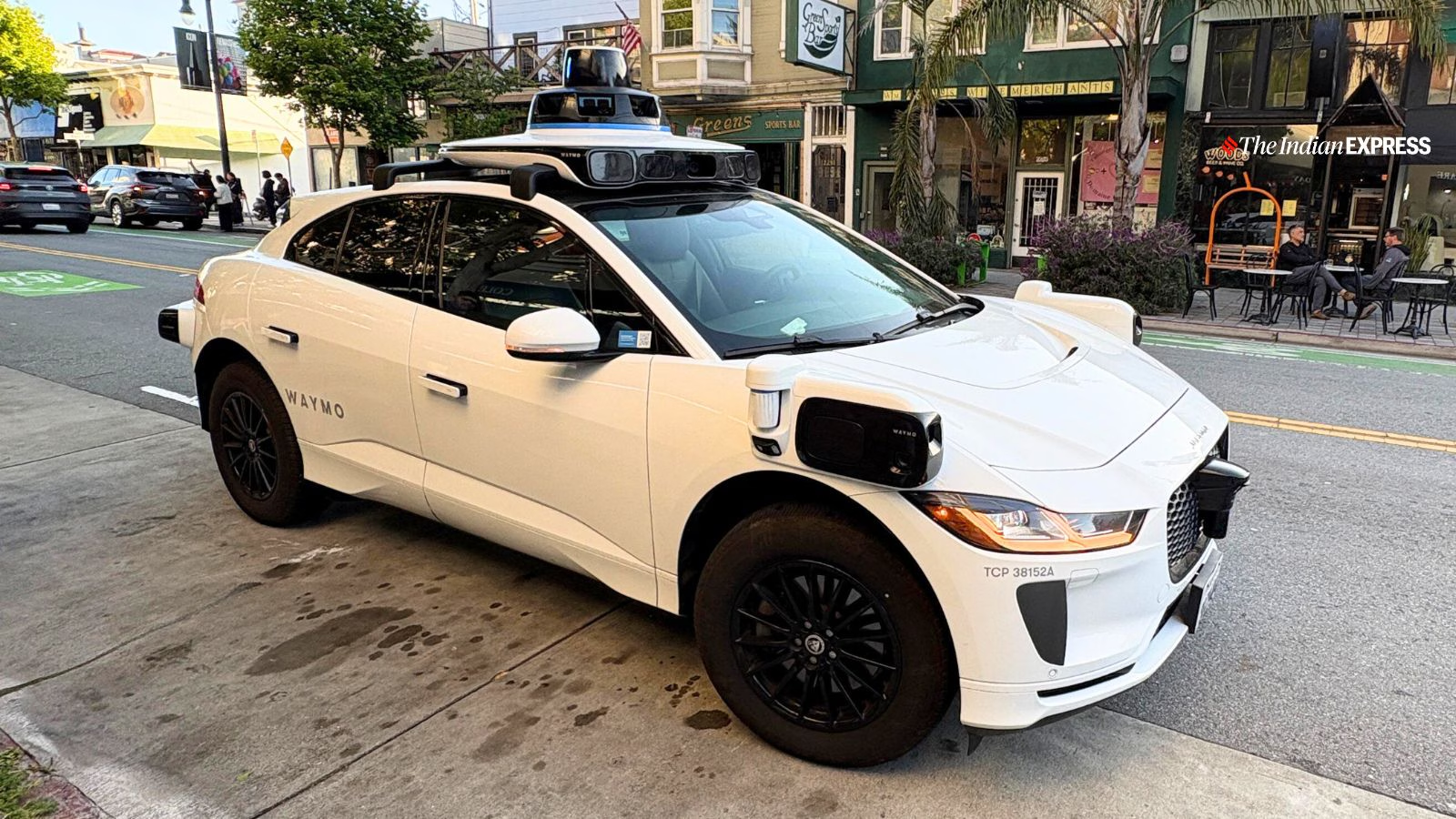
Connectivity is the Achilles heel of the autonomous dream. On December 19, 2025, at exactly 14:22 PST, a localized grid failure in San Francisco’s Northeast corridor did more than flicker the lights. It effectively lobotomized the Waymo Driver. While Alphabet Inc. marketing materials promise a vehicle that sees around corners, the reality on the ground was 422 Jaguar I-PACE SUVs frozen in the middle of active intersections. This was not a mechanical failure. It was a systemic collapse of the V2X (Vehicle-to-Everything) communication layer that these Level 4 systems require for high-stakes urban navigation.
According to initial reports from the San Francisco Department of Technology, the blackout knocked out three 6G micro-cells and triggered a latency spike in the AWS US-West-1 region. For a human driver, a loss of GPS or cell signal is an inconvenience. For Waymo, it is a catastrophic loss of the ‘remote backstop.’ When latency exceeds 150 milliseconds, the protocol dictates an immediate ‘Safe Stop.’ In the Tenderloin and Nob Hill, that meant dozens of driverless cars creating an instant, impenetrable gridlock.
Alphabet (GOOGL) Market Reaction: Dec 18-21, 2025
The Myth of Edge Autonomy
Investors often mistake autonomy for independence. The December 19 blackout exposed the tether. Waymo relies on a ‘Tele-Ops’ center where human technicians monitor the fleet. When the local data pipe burst, those technicians lost their eyes. This brings us to the skeptical core of the autonomous business model: if a car cannot navigate a three-block radius without a persistent high-speed data connection to a server farm, is it truly autonomous?
Alphabet’s latest SEC filings acknowledge ‘infrastructure dependencies’ as a risk factor, but the San Francisco incident proves these are not hypothetical edge cases. They are fundamental flaws. The vehicles are essentially thin clients on wheels. Without the cloud, the ‘Driver’ ceases to exist. This creates a terrifying liability profile for city regulators who are now realizing that a single transformer explosion can paralyze the city’s transport network.
Comparison of Infrastructure Dependency
| Feature | Waymo (L4) | Tesla FSD v13.3 | Cruise (L4 Re-entry) |
|---|---|---|---|
| Primary Sensor | LiDAR / Radar / Vision | Vision Only | LiDAR / Vision |
| Cloud Dependency | Critical (Tele-Ops) | High (Maps/Validation) | Critical (Remote) |
| Offline Capability | Minimal (Safe Stop) | Moderate (Inertial) | Minimal (Safe Stop) |
The Musk Pivot and the Vision Trap
Elon Musk was quick to capitalize on Waymo’s paralysis, claiming on X that Tesla’s ‘Vision-only’ architecture remained operational. While it is true that Tesla’s Full Self-Driving (FSD) v13.3 does not use the same ‘Tele-Ops’ backstop as Waymo, his claims of resilience are misleading. Market data from third-party trackers showed that Tesla disengagements in the blackout zone spiked by 400 percent on the same day. Without real-time traffic data and map tiles, Tesla’s neural nets struggled with lane logic in the dark intersections. Musk is selling a narrative of rugged independence, but the data suggests that Tesla was simply ‘less broken’ rather than ‘fully functional.’
The financial fallout for Alphabet is immediate. Waymo’s burn rate is estimated at $2.1 billion per quarter. Every hour the fleet is grounded in its flagship market, the path to profitability moves further into the 2030s. The ‘catch’ is that solving for a blackout requires a level of onboard compute and redundant power that would double the hardware cost of an already expensive vehicle. The industry is trapped between the cost of local intelligence and the fragility of cloud dependence.
The San Francisco Board of Supervisors is already drafting an emergency ordinance to require ‘offline fail-safes’ that would allow robotaxis to clear intersections without a data link. This is a technical hurdle that Waymo’s current hardware suite may not be able to clear without a significant retrofit. Watch for the California Public Utilities Commission (CPUC) hearing on January 14, 2026. The specific data point to track is whether the commission mandates a 100 percent ‘on-board redundancy’ for all Level 4 permits, a move that could effectively bankrupt smaller AV startups before the spring.