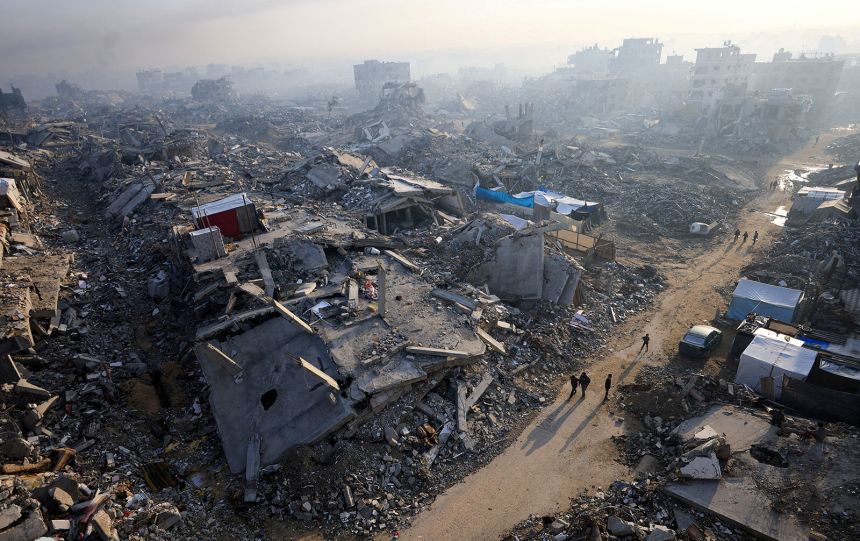
Capital is stagnant. Supply chains are frozen. The United Nations Development Programme (UNDP) issued a stark warning yesterday that technical capacity is no longer the issue. The bottleneck is physical access. Alexander De Croo, the head of the UNDP, stood amid the ruins of Gaza City on Tuesday to deliver a reality check to global markets. He confirmed that while the funds for early recovery exist, the gates to the enclave remain effectively locked for the machinery of reconstruction.
The Seven Year Rubble Problem
Ninety percent of the population now lives in the debris. It is a logistical nightmare of 61 million tonnes of twisted steel and pulverized concrete. Per the latest UNDP field assessment, only 0.5 percent of this rubble has been cleared since the ceasefire began last October. At the current rate of entry for heavy machinery, the clearance process will take seven years. This is not a projection of rebuilding. This is the timeline just to reach a blank slate.
Technical capacity is a hollow metric without throughput. The UNDP has 4,000 temporary housing units ready for deployment. Only 500 have been installed. The gap between “ready” and “delivered” is a function of border policy, not humanitarian failure. The World Bank notes that Gaza’s GDP contracted by 84 percent in 2025. Inflation has surged past 230 percent. The economy is not just in recession. It has been de-industrialized to a point of near-total dependence on external aid.
The Reconstruction Funding Gap
Gaza Reconstruction: The Pledged vs. Required Capital Gap (USD Billions)
The Board of Peace and the Five Billion Dollar Question
Political optics are clashing with actuarial reality. On Sunday, the newly formed Board of Peace announced a $5 billion commitment toward Gaza’s reconstruction. It sounds substantial. It is not. The joint estimate from the United Nations, the World Bank, and the European Union places the total cost of rebuilding at $70 billion. The current pledges cover barely 7 percent of the requirement. This is a rounding error in the context of a territory where 92 percent of the infrastructure has been destroyed.
Markets are reacting to the disconnect. There is talk of “Reconstruction Bonds” and private equity interest in a “New Gaza” waterfront. These are fantasies of the future that ignore the friction of the present. Investors are looking at a territory where 37 international aid organizations are currently facing a March 1 deadline to renew registrations under restrictive new terms. If these groups withdraw, the last remaining logistical networks for aid distribution will dissolve. The private sector cannot fill a void where there is no functioning legal or physical corridor.
The Logistics of Extortion
Reconstruction is becoming a tool of demographic engineering. The delay in cement and steel entry is not merely a security precaution. It is a strategic lever. By controlling the “faucet” of building materials, the authorities control where and how people return to their land. The UNDP reports that 200,000 to 300,000 housing units are needed immediately to move people out of rudimentary tents. Without these units, the population remains in a state of permanent displacement, vulnerable to the elements and political pressure.
The technical mechanism of this stagnation is the “dual-use” list. Items as simple as water pipes and solar panels are frequently blocked. This prevents the restoration of basic services like sewage treatment and electricity. In Khan Younis, three out of eight humanitarian missions were denied access this week alone. One of those missions was intended to reach a critical water treatment plant. When infrastructure cannot be repaired, the cost of future reconstruction compounds daily due to further decay and environmental contamination.
The next major data point for the region arrives on March 1. This is the deadline for NGOs to comply with new registration requirements or cease operations. If the current obstruction of UNDP personnel continues, the $70 billion reconstruction estimate will likely be revised upward by mid-year. Watch the Rafah and Kerem Shalom crossing tonnage reports. They are the only true indicators of whether the recovery has actually begun.