The S&P 500 just broke the math of diversification.
As of November 12, 2025, the narrative of a fragile, top-heavy market has collided with a brutal reality for the bears. The index dipped to 6,800 yesterday, yet it remains firmly entrenched in a bullish channel that has defied every historical precedent of the last sixty years. We are no longer trading a broad market. We are trading a tech-heavy club where the top ten companies now control a staggering 42 percent of the index total value. This concentration level has officially smashed the 29 percent peak of the Dot-Com era, yet the predicted collapse remains a ghost in the machine.
Citi’s Scott Chronert is betting on the tax pivot.
While the ‘Tilt Test’ skeptics point to the 4.6 percent unemployment rate and the stalling labor market, Citi strategists led by Scott Chronert have aggressively raised their targets. Citi now projects a year-end base case of 6,600, with a bull-case extension toward 7,200 if the fiscal stimulus from the April tax bill fully offsets the friction of new trade tariffs. The technical mechanism here is simple. Earnings are finally catching up to the valuations. Citi has revised its 2025 earnings-per-share (EPS) forecast to $272, with a massive jump to $308 projected for 2026. This is not a bubble built on air. It is a fundamental repricing of productivity in the age of 5 trillion dollar valuations.
The data dark hole of November.
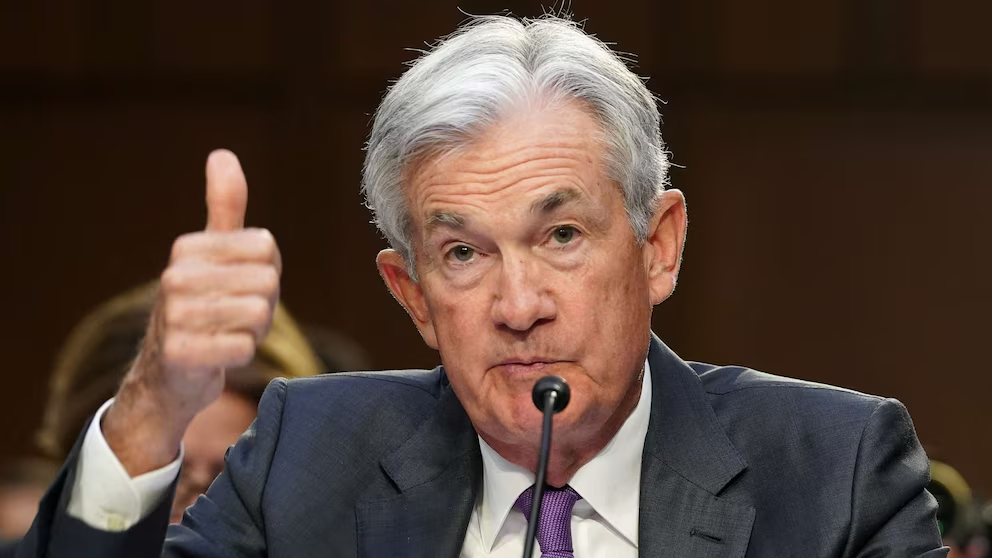
Investors are currently flying blind. The 43-day government shutdown that paralyzed Washington in October has left a massive gap in the economic record. The Bureau of Labor Statistics (BLS) essentially skipped the October CPI report, and the November inflation data arriving later this week is expected to be a messy, non-comparable ‘one-off’ print of roughly 3.1 percent. This lack of transparency has created a ‘dark hole’ for the Federal Reserve. Fed Chair Jerome Powell, facing intense pressure after the 25-basis point cuts in September and October, now sits in a defensive posture. The market is pricing in a 50-50 toss-up for the December 10 FOMC meeting, with the fed funds rate currently hanging in the 3.75 to 4.00 percent range.
Nvidia and the $19 Trillion Club.
The sheer scale of the current concentration is difficult to wrap the human mind around. Nvidia, which recently became the first company to eclipse a $5 trillion market cap, now commands an 8 percent weight in the S&P 500. When you add Microsoft at 6.7 percent and Apple at 5.6 percent, three companies effectively dictate nearly a quarter of the entire American equity landscape. This ‘winner-takes-all’ system, powered by the AI infrastructure boom, has rendered traditional diversification models obsolete. Per the latest 13F filings from Q3 2025, institutional conviction in these mega-caps has actually increased despite the valuation warnings.
Comparing Sector Performance and EPS Growth.
The following table breaks down the internal divergence of the S&P 500 as we approach the final weeks of 2025. While Information Technology dominates the weighting, the ‘Catch-Up’ trade is beginning to surface in Financials and Energy as tax policy clarity emerges.
| Sector | Index Weight (%) | 2025 EPS Growth (Est) | 2026 EPS Target |
|---|---|---|---|
| Information Technology | 34.2% | +24.1% | $342 |
| Financials | 12.8% | +9.4% | $118 |
| Health Care | 11.5% | +6.2% | $95 |
| Consumer Discretionary | 10.1% | +11.8% | $104 |
| Energy | 3.9% | +4.1% | $82 |
The path forward rests on the December 10 pivot.
The immediate risk is not a bubble burst, but a data-driven paralysis. If the upcoming CPI print on Thursday exceeds 3.1 percent due to the lingering effects of the 43-day shutdown and the initial tariff implementation, the Fed will be forced to hold rates steady in December. This would likely trigger a tactical rotation out of the ‘Magnificent Seven’ and into the equal-weighted S&P 500 (RSP), which has lagged the market-cap index by nearly 12 percent year-to-date. Watch the 6,780 support level on the S&P 500. A breach there would signal that the ‘Santa Claus rally’ is being deferred until the first 13F releases of 2026. The next major milestone to watch is the January 28 Federal Reserve meeting, where the 2026 interest rate trajectory will be set in stone based on the first clean inflation data in three months.