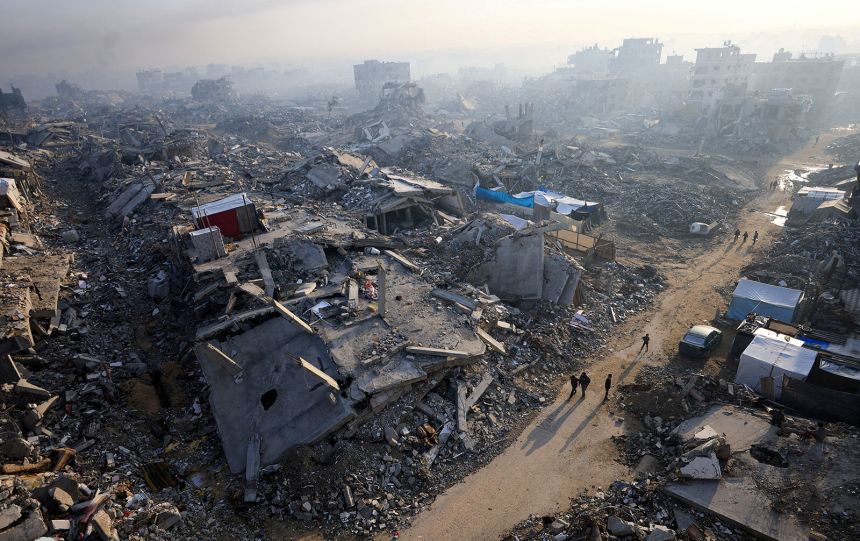
The Ledger of Ruin
Money likes stability. Gaza has none. As of November 25, 2025, the arrival of the winter rains has transformed the humanitarian crisis into a massive financial friction point. While the headlines focus on the tragedy of the flooding in Al-Mawasi, the smart money is looking at the stalled reconstruction ledger. The $18.5 billion damage assessment issued earlier this year by the World Bank has now ballooned. Every day of rain is a day where heavy machinery cannot move, and every day of delay adds roughly 0.5 percent to the eventual mobilization costs for international contractors.
The narrative of reconstruction is often sold as a humanitarian effort, but for the global financial markets, it is a high-risk insurance and logistics play. The rain is not just weather. It is a force majeure event that is currently freezing the deployment of capital from the Gaza Reconstruction Fund. If the equipment cannot reach the site, the burn rate for NGOs and private contractors increases without a single brick being laid. This is where the alpha disappears.
The Disconnect Between Pledges and Disbursal
Global powers have been vocal about their commitments. However, the gap between a diplomatic pledge and a wire transfer remains a canyon. According to the latest Reuters reports from the November 23 summit, only 14 percent of the promised reconstruction capital has been moved into verified escrow accounts. The reason is simple. No institutional investor or sovereign wealth fund will release billions into a flood zone that lacks a functional drainage system or a recognized security guarantee.
We are seeing a unique form of ‘logistical stagflation’ in the region. The cost of basic construction materials like Portland cement and rebar has spiked by 22 percent since October 2025 due to the bottleneck at the Kerem Shalom crossing. The rain has turned the makeshift dirt roads into impassable quagmires, effectively cutting the supply chain in half. For firms like Bechtel or Fluor, which the previous commentary suggested might pivot on a dime, the reality is far more rigid. These giants do not move without ironclad sovereign guarantees and a clear ‘site ready’ certification. The mud ensures that certification is months away.
Capital Flow vs. Reconstruction Cost
The Logistics of Despair as an Asset Class
Risk premiums are currently at an all-time high for any maritime or overland logistics provider operating near the Gaza coast. The recent flooding has destroyed 40 percent of the temporary storage facilities erected during the summer. This is not just a humanitarian disaster. It is a total loss of ‘pre-positioned assets’ for the companies involved in the aid pipeline. Investors tracking the performance of defense and logistics conglomerates like RTX or Maersk must account for the fact that Gaza is currently a ‘sunk cost’ environment.
The technical mechanism of the current economic failure is a ‘liquidity trap’ within the aid sector. Donors are hesitant to send funds that will literally be washed away by the next storm. Meanwhile, the lack of funds prevents the construction of the very drainage systems needed to protect future investments. It is a circular failure of capital deployment. The following table illustrates the current state of major donor contributions as of this morning.
| Donor Nation / Entity | Total Pledge (USD B) | Actual Disbursed (%) | Primary Focus |
|---|---|---|---|
| European Union | 1.2 | 18% | Water & Sanitation |
| United States | 0.9 | 12% | Emergency Food Aid |
| Qatar | 2.5 | 35% | Energy & Fuel |
| World Bank Group | 0.5 | 8% | SME Recovery |
The Health Crisis is a Productivity Killer
Public health is often viewed through a lens of empathy, but in investigative finance, it is a matter of labor availability. The surge in waterborne diseases following the November 22 flooding has sidelined an estimated 30 percent of the local workforce currently employed in debris removal. This labor shortage drives up the cost of the few functional projects remaining. According to data from the World Health Organization update, the lack of clean water is now the primary bottleneck for the reopening of the small-scale industrial zones in the north.
For the institutional observer, the ‘yield’ on Gaza reconstruction is currently negative. The reward for being an early mover in this market is being buried in the mud of a winter storm without a clear exit strategy. The focus has shifted from rebuilding to mere survival, which pauses the economic velocity of the entire region. The volatility in the Israeli Shekel and the Jordanian Dinar over the last 48 hours reflects this regional uncertainty as the crisis spills over borders via migration and trade disruptions.
Watching the January Threshold
The next critical data point for the market is January 12, 2026. This is the scheduled date for the next UNRWA budget audit and the expiration of the current temporary maritime pier lease. If the winter weather continues to degrade the existing infrastructure at the current rate, the cost of the maritime corridor will triple as specialized dredging becomes mandatory. The market is currently pricing in a 65 percent chance of a total logistics halt before the end of the year. Watch the Baltic Dry Index for any unusual spikes in regional shipping rates, as this will be the first indicator of a shift from ‘humanitarian aid’ to ‘forced reconstruction’ at any cost.