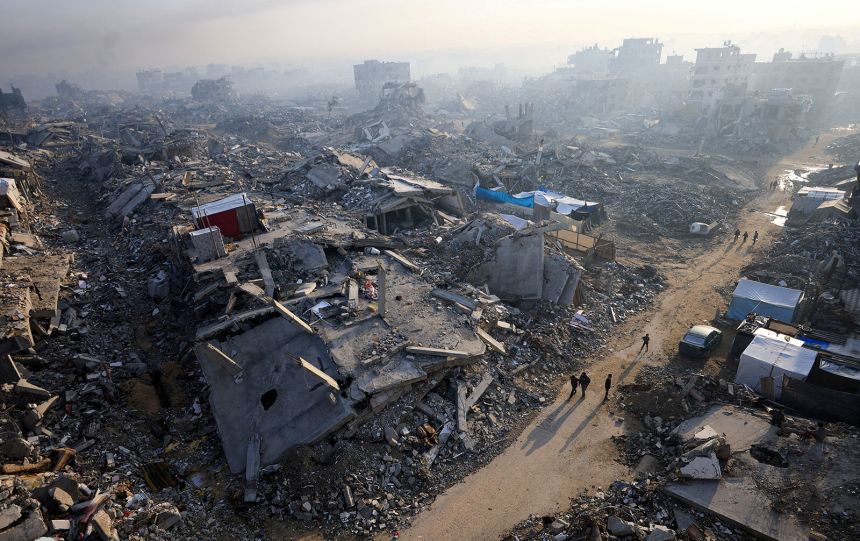
The Ghost Economy of the Enclave
The numbers are staggering. Gaza is currently operating at a fraction of its pre-conflict capacity. Markets are hollowed out. Traditional commerce has vanished. On February 5, 2026, the primary currency in the streets is no longer the Shekel or the Dollar, but the promise of emergency labor. The United Nations Development Programme (UNDP) has pivoted its strategy toward what it calls emergency employment. This is not a standard job market. It is a desperate liquidity injection designed to prevent total societal atrophy.
Capital is stagnant. According to recent reports from Reuters, the physical destruction of infrastructure has rendered traditional industrial output impossible. The UNDP tweet issued today highlights a critical shift. They are deploying young medical professionals not just to heal, but to rebuild. This is a forced evolution. When a surgeon becomes a community architect, the traditional economic models of labor specialization have failed. The goal is simple. Boost income generation immediately. Support skills. Strengthen public services that are currently on life support.
The Mechanics of Emergency Employment
Liquidity is the oxygen of any economy. Without it, the market suffocates. Gaza is currently in a state of respiratory failure. The emergency employment model operates as a temporary bypass. By paying young professionals to serve their own communities, the UNDP is effectively creating a closed-loop economy. This prevents the total flight of human capital. If the doctors and engineers leave, there is no foundation for a future recovery. The current focus on income generation is a tactical move to keep the remaining population from falling into absolute dependency.
The technical mechanism is straightforward. International donors provide the hard currency. This currency is then distributed as wages for labor-intensive public works. This is not charity. It is a stabilization effort. Per analysis from Bloomberg, the multiplier effect of these wages is high because the marginal propensity to consume in Gaza is nearly 100 percent. Every dollar paid out in emergency wages is immediately spent on basic necessities, providing a tiny spark to local vendors who still manage to operate in the ruins.
Gaza Labor Market Composition February 2026
The Human Capital Crisis
Brain drain is the silent killer. Gaza’s youth are highly educated but largely idle. The UNDP’s focus on medical professionals is a recognition of this specific vulnerability. If the health sector collapses entirely, the cost of reconstruction triples. By providing emergency employment to these professionals, the international community is essentially paying a premium to keep them in the territory. This is a strategic holding pattern. It is an attempt to preserve the skeletal structure of a functioning society until a more permanent political and economic settlement can be reached.
However, the risks are immense. This is an artificial economy. It relies entirely on the whims of international donor fatigue. If the funding for emergency employment dries up before the formal sector can be restarted, the resulting crash will be catastrophic. The World Bank has warned that the transition from emergency aid to sustainable development is the most dangerous phase of post-conflict recovery. Gaza is currently stuck in the middle of this transition.
Economic Indicators Comparison February 2026
| Indicator | Gaza Strip | West Bank | Regional Average |
|---|---|---|---|
| Unemployment Rate | 78% | 24% | 14% |
| GDP Growth (Projected) | -12% | +2.1% | +3.5% |
| Inflation (YoY) | 45% | 6.2% | 5.1% |
| Aid Dependency | 92% | 18% | 4% |
The Infrastructure Bottleneck
Rebuilding is not just about labor. It is about materials. The dual-use restrictions on construction supplies continue to throttle the pace of recovery. Even if the UNDP employs ten thousand engineers, they cannot build without cement and steel. The emergency employment programs often focus on services and debris removal because these tasks require the fewest imported inputs. This is a pragmatic choice, but it limits the long-term impact of the intervention. We are seeing a workforce that is over-qualified for the tasks they are allowed to perform.
The financial logistics are equally complex. The banking system in Gaza is fragmented. Digital payments are becoming the norm because physical cash is difficult to transport across checkpoints. This has led to a surge in fintech experiments within the enclave. Some local startups are attempting to bridge the gap using blockchain-based ledger systems to track aid distribution and wage payments. This is a high-tech solution to a medieval problem. It remains to be seen if these systems can scale without a stable internet backbone, which is currently intermittent at best.
The next critical milestone is the April 2026 Donor Coordination Conference in Brussels. Markets are watching the pledged versus actual disbursement rates. If the gap between promises and payments does not close, the emergency employment programs will run out of capital by mid-summer. The key metric to watch is the ‘Disbursement Velocity Index’ which currently sits at a record low of 0.34.