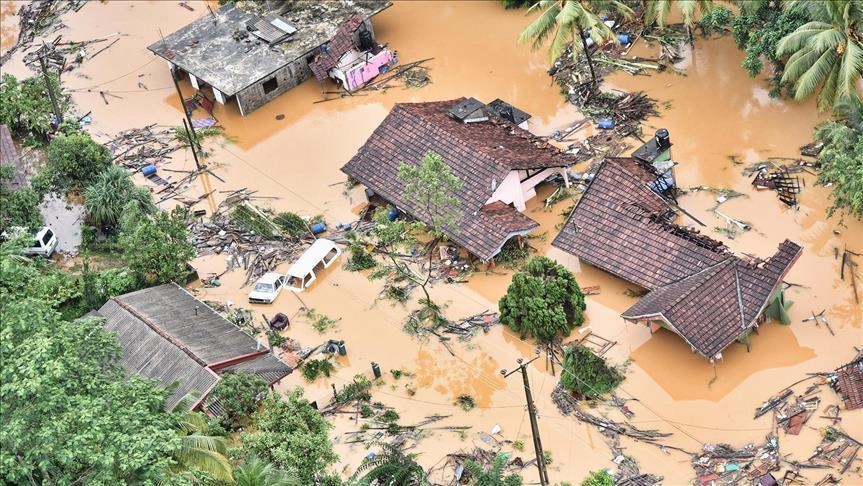
The Financial Fault Lines of Cyclone Ditwah
The rain did not just wash away topsoil in the Central Highlands. It dissolved the fragile math of a sovereign recovery. While the United Nations Development Programme tracks the 2.3 million lives upended by Cyclone Ditwah, the markets are tracking a different metric. The Sri Lankan Rupee (LKR) buckled under the pressure on December 8, 2025, sliding against the dollar as the cost of emergency imports began to cannibalize thin foreign reserves. This is not just a humanitarian crisis. It is a balance sheet disaster.
Follow the money. The 20 percent of the population now exposed to the floodwaters represents the backbone of the nation’s informal economy. In the districts of Ratnapura and Kalutara, small scale rubber and tea holders have seen their entire capital base liquidated by mudslides. For a nation already under the thumb of an IMF Extended Fund Facility, the timing is catastrophic. Every dollar spent on disaster relief is a dollar diverted from debt servicing. The risk is no longer just atmospheric. It is systemic.
Visualizing the Economic Shock
Black Tea and Red Ink
Tea is the lifeblood of the export sector. But as of the December 9 Colombo Tea Auction, the narrative has shifted from quality to scarcity. High grown estates report a 40 percent destruction of nursery stocks. This is a multi year setback. A tea bush takes years to mature. You cannot simply replant and recover by the next quarter. According to Bloomberg commodity data, the price of Ceylon Black Tea is spiking, yet local producers cannot capitalize because their logistics chains are submerged.
The impact on women is particularly acute from a financial standpoint. In the tea sector, women make up the majority of the plucking workforce. Their income is daily. No plucking means no pay. This creates a secondary credit crisis. These women are the primary borrowers from microfinance institutions. With their income streams severed, a wave of micro-defaults is beginning to ripple through the rural banking sector. This is the part the NGO press releases miss. The destruction of the micro-credit loop can be more permanent than the floodwaters themselves.
The Reconstruction Arbitrage
Where there is disaster, there is opportunistic capital. While the Colombo Stock Exchange (CSE) saw an initial dip, construction and materials stocks are showing a perverse resilience. Sophisticated investors are betting on the inevitable infrastructure contracts. The government must rebuild the bridges and roads connecting the southern export zones to the Colombo port. The question is who pays? The national treasury is dry. The world is watching the Reuters currency tickers to see if the central bank resorts to the printing press, a move that would reignite the hyperinflation ghosts of 2022.
| Economic Indicator | Pre-Ditwah (Nov 2025) | Post-Ditwah (Dec 10, 2025) | Variance |
|---|---|---|---|
| LKR per USD | 312.40 | 328.15 | +5.04% |
| Tea Export Volume (Tons) | 22,000 | 14,500 | -34.09% |
| Foreign Reserves (USD Bn) | 4.2 | 3.8 | -9.52% |
| Inflation (Y-o-Y) | 5.1% | 6.8% | +33.33% |
Sovereign Default or Climate Clause?
The most significant financial battle is happening behind closed doors in Washington and Colombo. Sri Lanka’s debt restructuring agreements did not include robust climate resilient clauses. This was a massive oversight. Now, the government is forced to argue for a temporary moratorium on interest payments based on an act of god. Bondholders are skeptical. They see a nation that was just beginning to find its footing and they fear the cyclone is being used as a convenient excuse for fiscal slippage.
Technical mechanisms of the current recovery scams are already surfacing. In the Gampaha district, local middlemen are reportedly hoarding construction supplies, creating an artificial shortage to drive up prices before the government relief tenders are even issued. This is the dark side of the recovery. The profit margins on misery are high. Investigative leads suggest that several shell companies registered in early 2025 have suddenly secured the rights to import heavy machinery, suggesting an advance knowledge of the vulnerabilities in the flood defenses.
The recovery effort is also failing the transparency test. Only 15 percent of the initial emergency fund has reached the ground level. The rest is tangled in a web of bureaucratic verification that serves only to delay the inevitable. For the small business owner in Matara, this delay is a death sentence. Their equipment is rusting in salt water while they wait for a surveyor who may never come. The gap between the high level data and the street level reality is a canyon.
The financial markets will find a new equilibrium, but the cost of that stability will be borne by the 2.3 million people the UNDP identified. They are the collateral in a larger game of sovereign survival. As the floodwaters recede, they leave behind a layer of silt and a mountain of unpayable debt. The next critical data point for the island’s survival is not a weather report. It is the March 15, 2026, IMF review of the primary surplus targets. If the cost of Ditwah pushes the deficit beyond the agreed threshold, the entire debt restructuring house of cards could collapse before the monsoon season begins.