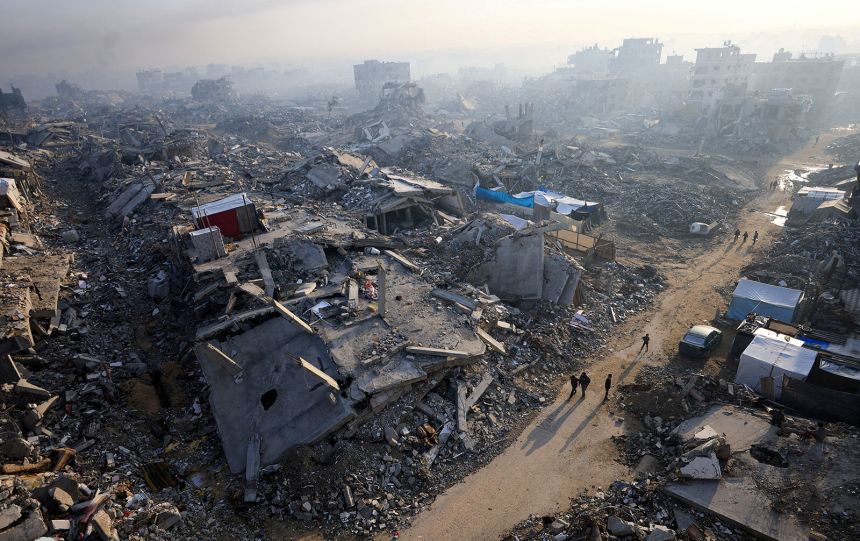
The Rubble Economy
Capital follows stability. In Gaza, stability is a ghost. The United Nations Development Programme (UNDP) recently highlighted the efforts of the local workforce in clearing rubble and restoring water. These are not just humanitarian acts. They are the first tremors of a massive, state-led reconstruction market that remains starved of actual liquidity. The scale of destruction defies standard insurance modeling. Over 40 million tons of debris litter the landscape. Much of it is contaminated with unexploded ordnance and hazardous materials. This is not a simple cleanup. It is a multi-decade industrial project requiring specialized logistics that currently do not exist at scale in the region.
The Infrastructure Deficit
Water is the primary currency of survival. The UNDP reports that clean water delivery is being restored liter by liter. This is a stopgap. Before the conflict, Gaza’s aquifer was already 95 percent unfit for human consumption due to over-extraction and seawater intrusion. The current restoration efforts focus on repairing localized networks. However, the macro-level requirement is for massive desalination investment. According to data tracked by Bloomberg, the cost of restoring basic utility services in high-conflict zones typically exceeds initial estimates by 300 percent due to supply chain bottlenecks and security premiums.
The Labor Arbitrage
Local hands do the heavy lifting. The UNDP emphasizes that the local workforce is the backbone of the current recovery. This is a tactical necessity. International contractors are hesitant to deploy high-value assets into a zone with zero sovereign risk protection. By utilizing local labor, the UNDP reduces the immediate capital outlay. Yet, this creates a secondary economic problem. The lack of heavy machinery means the pace of clearing is dictated by manual capacity. At the current rate, clearing the 42 million tons of rubble could take until the mid-2030s. The technical challenge is the sheer density of the debris. In urban centers like Gaza City, the rubble is not just concrete. It is a complex mix of rebar, household chemicals, and human remains. This requires forensic-level sorting that manual labor cannot sustain indefinitely.
Estimated Reconstruction Costs by Sector
| Sector | Estimated Damage (USD Billions) | Recovery Status (Jan 2026) |
|---|---|---|
| Housing | 18.5 | Minimal / Temporary Shelters |
| Water & Sanitation | 4.2 | Critical Repairs Ongoing |
| Energy Grid | 3.1 | Fragmented / Solar Dependent |
| Transportation | 2.8 | Primary Arteries Cleared |
Funding is the ultimate bottleneck. Pledges made at international summits rarely translate into immediate cash flow. The gap between humanitarian aid and reconstruction capital is widening. Private equity is non-existent. Sovereign wealth funds from the region are cautious. They demand political guarantees that the infrastructure built today will not be leveled tomorrow. Without a multilateral insurance mechanism, the reconstruction remains a series of disconnected charity projects rather than a cohesive economic recovery.
Visualizing the Funding Gap
Gaza Reconstruction: Funding Requirements vs. Actual Disbursements
The Technical Cost of Rubble
Logistics determine the timeline. Moving 40 million tons of debris requires a fleet of thousands of heavy-duty trucks. The fuel costs alone are staggering. Per reports from Reuters, the logistics of cross-border movement remain the single greatest friction point for reconstruction. Every ton of rubble cleared is a victory of grit over geometry. But grit does not scale. Only industrial-grade machinery and consistent supply lines can move the needle. The UNDP’s focus on ‘layers of safety’ is an admission that the core structure remains broken. We are currently in the ‘first layer’ phase. This involves basic clearing and sanitation. The ‘second layer’—permanent housing and industrial zones—requires a level of capital commitment that the market has yet to provide.
The Forward Outlook
Watch the cement. The price of construction materials in the Levant is the leading indicator for Gaza’s future. If regional cement producers begin securing long-term supply contracts for the Gaza border, it signals that the political risk has been mitigated. Currently, those contracts do not exist. The next critical milestone is the March 2026 Infrastructure Assessment Review. This report will determine if the ‘early recovery’ phase has successfully transitioned into a sustainable reconstruction model. Until then, the economy remains a series of manual interventions in a landscape of ruins. The specific data point to monitor is the daily tonnage of rubble processed through the newly established recycling centers. If that number does not triple by the end of the first quarter, the 2035 recovery target will be a fantasy.